

Dubai chocolate dazzles with bold flavors and opulent ingredients, while Swiss chocolate wins hearts with smooth texture and centuries-old craftsmanship. Both offer unique experiences—luxury versus tradition—so the “better” choice depends on your taste.
When it comes to chocolate, few debates spark as much passion as the one between tradition and innovation. On one side, you have Swiss chocolate—a symbol of European elegance, precision, and time-honored craftsmanship. On the other, Dubai chocolate—a dazzling newcomer that blends luxury, exotic flavors, and modern flair. Both are delicious, both are luxurious, but they represent very different philosophies of what chocolate should be.
Imagine unwrapping a smooth, foil-wrapped bar of Swiss milk chocolate. The snap is clean, the melt is velvety, and the flavor is rich yet balanced—creamy, slightly sweet, with a hint of nuttiness. Now picture a handcrafted Dubai chocolate truffle, dusted in edible gold and filled with rosewater-infused ganache and crushed pistachios. It’s rich, fragrant, and unforgettable. These two experiences couldn’t be more different, yet both are deeply satisfying in their own ways.
So, which is better? The answer isn’t black and white. It depends on what you’re craving: comfort or adventure, tradition or novelty, subtlety or spectacle. In this deep dive, we’ll explore the origins, ingredients, production methods, cultural significance, and taste profiles of both Dubai and Swiss chocolate. By the end, you’ll have all the tools to decide which one deserves a spot in your pantry—or your next gift basket.
Contents
- 1 Key Takeaways
- 2 Quick Answers to Common Questions
- 3 📑 Table of Contents
- 4 A Tale of Two Chocolates: Origins and Heritage
- 5 Ingredients and Flavor Profiles: What Sets Them Apart
- 6 Production Methods: Tradition vs. Innovation
- 7 Cultural Significance: Chocolate as Identity
- 8 Taste Test: Which One Wins Your Palate?
- 9 Price and Accessibility: What You’re Paying For
- 10 Which Is Better? The Final Verdict
- 11 Frequently Asked Questions
Key Takeaways
- Swiss chocolate is renowned for its creamy texture and high milk content, thanks to Alpine dairy and precise tempering techniques.
- Dubai chocolate embraces innovation with exotic spices, gold leaf, and Middle Eastern flavors like saffron, cardamom, and dates.
- Swiss chocolate has a rich history dating back to the 1800s, with brands like Lindt and Toblerone leading global quality standards.
- Dubai chocolate reflects the city’s luxury lifestyle, often served in gold boxes and marketed as a high-end gift or souvenir.
- Swiss chocolate excels in consistency and purity, while Dubai chocolate prioritizes boldness and sensory surprise.
- Both chocolates use premium cocoa, but sourcing and processing methods differ significantly due to climate and cultural preferences.
- Your preference may come down to mood: Swiss for comfort and tradition, Dubai for adventure and indulgence.
Quick Answers to Common Questions
Is Dubai chocolate really made in Dubai?
Not always. While many Dubai-inspired chocolates are crafted in the UAE, some are made elsewhere and marketed as “Dubai-style” due to their Middle Eastern flavors. Always check the label for origin.
Can I find Swiss chocolate in Dubai?
Absolutely! Swiss brands like Lindt and Toblerone are widely available in Dubai’s supermarkets, airports, and luxury boutiques. You can even visit Lindt Chocolate Heaven at Dubai Mall.
Is Dubai chocolate suitable for vegans?
Some are! Look for dark chocolate varieties made without milk or animal products. Many Dubai chocolatiers now offer vegan options using coconut milk or almond milk.
Why is Swiss chocolate so creamy?
It’s the high milk content and conching process. Swiss chocolatiers use fresh Alpine milk and long conching times to create that signature smooth, melt-in-your-mouth texture.
What makes Dubai chocolate unique?
Its use of exotic ingredients like saffron, rosewater, dates, and edible gold—flavors deeply rooted in Middle Eastern culture—sets it apart from traditional chocolate.
📑 Table of Contents
- A Tale of Two Chocolates: Origins and Heritage
- Ingredients and Flavor Profiles: What Sets Them Apart
- Production Methods: Tradition vs. Innovation
- Cultural Significance: Chocolate as Identity
- Taste Test: Which One Wins Your Palate?
- Price and Accessibility: What You’re Paying For
- Which Is Better? The Final Verdict
A Tale of Two Chocolates: Origins and Heritage
To truly understand the difference between Dubai and Swiss chocolate, we need to go back to where it all began. Chocolate, in its modern form, has roots in Europe, but its evolution took dramatically different paths in Switzerland and the Middle East.
The Swiss Legacy: Precision Meets Purity
Switzerland’s love affair with chocolate began in the early 19th century. While chocolate had been consumed in Europe since the Spanish brought it from the Americas, it was the Swiss who revolutionized it. In 1819, François-Louis Cailler opened the first Swiss chocolate factory, laying the foundation for a national obsession. But the real breakthrough came in 1875, when Daniel Peter, a Swiss chocolatier, invented milk chocolate by combining cocoa with condensed milk—thanks to a partnership with Henri Nestlé.
This innovation changed everything. Swiss milk chocolate quickly became famous for its smooth, creamy texture, a result of high-quality Alpine milk and meticulous processing. The Swiss also perfected conching—a method of grinding and aerating chocolate to develop flavor and texture—pioneered by Rodolphe Lindt in 1879. This process gives Swiss chocolate its signature melt-in-your-mouth quality.
Over time, Swiss chocolate became synonymous with excellence. Strict regulations ensure that Swiss chocolate must contain at least 35% cocoa solids and no vegetable fats other than cocoa butter. This commitment to purity has made Swiss brands like Lindt, Toblerone, and Sprüngli household names worldwide.
Dubai’s Sweet Rise: Luxury Meets Innovation
Dubai, on the other hand, doesn’t have a centuries-old chocolate tradition. Instead, it has built a reputation for luxury, innovation, and cultural fusion. As a global hub for tourism and commerce, Dubai has embraced chocolate as a symbol of indulgence and status.
The rise of Dubai chocolate began in the early 2000s, as the city transformed into a playground for the wealthy. High-end hotels, luxury boutiques, and gourmet cafes started offering artisanal chocolates infused with local flavors. Think saffron, cardamom, rosewater, and dates—ingredients deeply rooted in Middle Eastern cuisine.
Unlike Swiss chocolate, which values consistency and tradition, Dubai chocolate thrives on creativity. Chocolatiers in Dubai often experiment with bold combinations, luxurious packaging, and theatrical presentation. A single chocolate box might include flavors like camel milk chocolate, saffron-infused dark chocolate, or gold-dusted pralines filled with date caramel.
This approach reflects Dubai’s identity: a city that blends tradition with futurism, where old-world charm meets cutting-edge design. Chocolate, in this context, isn’t just a treat—it’s an experience.
Ingredients and Flavor Profiles: What Sets Them Apart

Visual guide about Dubai Chocolate vs Swiss Chocolate Which Is Better
Image source: snackhistory.com
Now that we’ve explored the origins, let’s dive into what actually goes into these chocolates—and how that affects the taste.
Swiss Chocolate: The Art of Balance
Swiss chocolate is all about harmony. The flavor profile is smooth, creamy, and subtly sweet, with a rich cocoa backbone. The high milk content—often from cows grazing in the Alpine meadows—gives it a luxurious mouthfeel. Swiss chocolatiers also use precise roasting and conching techniques to develop deep, complex flavors without overpowering the palate.
Common ingredients include:
– High-quality cocoa beans (often from Ghana, Ecuador, or Madagascar)
– Fresh Alpine milk or milk powder
– Cane sugar
– Cocoa butter
– Natural vanilla
You’ll rarely find artificial flavors or preservatives in premium Swiss chocolate. Instead, the focus is on enhancing the natural taste of cocoa and milk. For example, Lindt’s Excellence 70% Dark Chocolate uses only four ingredients: cocoa mass, cocoa butter, sugar, and vanilla. The result? A rich, intense chocolate with a smooth finish.
Swiss chocolate also comes in a variety of styles:
– Milk chocolate: Creamy and sweet, perfect for everyday enjoyment.
– Dark chocolate: Bold and complex, with varying cocoa percentages.
– White chocolate: Made from cocoa butter, sugar, and milk—smooth and buttery.
The consistency is key. Whether you’re biting into a Toblerone bar or a Sprüngli truffle, you know exactly what to expect: quality, balance, and refinement.
Dubai Chocolate: Bold, Aromatic, and Unforgettable
Dubai chocolate, by contrast, is anything but subtle. It’s designed to surprise and delight the senses with bold, aromatic flavors that reflect the region’s culinary heritage.
Common ingredients include:
– Premium cocoa (often sourced from single-origin farms)
– Dates, pistachios, and almonds (staples of Middle Eastern cuisine)
– Saffron, cardamom, and rosewater (for fragrance and depth)
– Camel milk (a unique twist offering a slightly salty, creamy flavor)
– Edible gold leaf (for visual luxury)
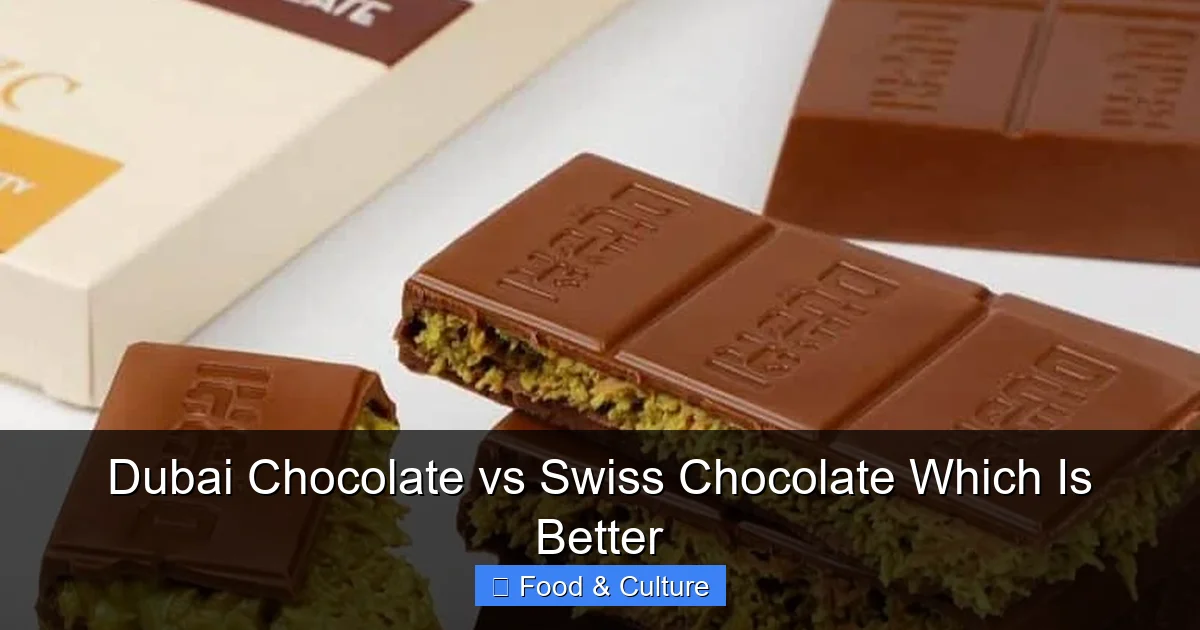
One popular Dubai chocolate is the “Saffron Delight” truffle—dark chocolate ganache infused with saffron threads, wrapped in a white chocolate shell, and dusted with gold. Another favorite is the “Date & Cardamom” bar, combining rich dark chocolate with chewy date paste and warm spice.
These flavors aren’t just for show—they’re deeply cultural. Saffron and rosewater, for instance, are used in traditional Arabic desserts like baklava and maamoul. By incorporating them into chocolate, Dubai chocolatiers create a bridge between past and present.
The texture can vary widely. Some Dubai chocolates are smooth and creamy, while others have crunchy inclusions like crushed nuts or crispy rice. The experience is often multi-sensory: the scent of rosewater hits first, followed by the crunch of pistachios, then the melt of chocolate on the tongue.
Production Methods: Tradition vs. Innovation
Visual guide about Dubai Chocolate vs Swiss Chocolate Which Is Better
Image source: snackhistory.com
How chocolate is made plays a huge role in its final taste and texture. Let’s compare the production processes of Swiss and Dubai chocolate.
Swiss Precision: Science and Craftsmanship
Swiss chocolate production is a blend of art and science. It begins with sourcing high-quality cocoa beans, which are fermented, dried, and roasted to develop flavor. The beans are then ground into a thick paste called chocolate liquor.
Next comes conching—a process that can last anywhere from a few hours to several days. During conching, the chocolate is continuously mixed and aerated at controlled temperatures. This removes unwanted acids and moisture, smooths the texture, and enhances flavor.
Tempering is another critical step. Chocolate is carefully heated and cooled to stabilize the cocoa butter crystals, giving the final product a glossy finish and a satisfying snap. Swiss chocolatiers are masters of tempering, ensuring every bar melts smoothly and holds its shape.
Finally, the chocolate is molded, cooled, and packaged. The entire process is highly regulated, with strict quality controls at every stage. This precision is why Swiss chocolate is so consistent—whether you’re in Zurich or Tokyo, a Lindt bar tastes the same.
Dubai Creativity: Artisanal and Experimental
Dubai chocolate production is more artisanal and experimental. While many Dubai chocolatiers use high-quality cocoa and follow traditional methods, they’re not afraid to innovate.
For example, some use small-batch roasting to bring out unique flavor notes in the beans. Others incorporate local ingredients at various stages—infusing cream with saffron before making ganache, or blending cardamom into the chocolate mass during conching.
Packaging is also a big part of the process. Dubai chocolates are often hand-wrapped in gold foil, placed in ornate boxes, or presented in decorative tins. The presentation is as important as the taste—after all, these chocolates are often bought as gifts or souvenirs.
Because Dubai chocolate is less standardized, there’s more variation between brands and batches. One chocolatier might make a floral rosewater truffle, while another focuses on spicy chili-chocolate combinations. This diversity is part of the appeal—it keeps the experience fresh and exciting.
Cultural Significance: Chocolate as Identity

Visual guide about Dubai Chocolate vs Swiss Chocolate Which Is Better
Image source: cdn.twocontinents.com
Chocolate isn’t just food—it’s culture. In both Switzerland and Dubai, chocolate reflects national identity, values, and lifestyle.
Swiss Chocolate: A Symbol of Quality and Trust
In Switzerland, chocolate is more than a treat—it’s a point of national pride. The Swiss consume more chocolate per capita than almost any other country (around 19 pounds per person annually). It’s common to give chocolate as a gift, whether for birthdays, holidays, or as a thank-you gesture.
Swiss chocolate represents reliability, precision, and understated elegance. It’s not flashy—it doesn’t need to be. The quality speaks for itself. This aligns with Swiss values: punctuality, craftsmanship, and discretion.
Even the packaging reflects this ethos. Swiss chocolate bars are often wrapped in simple foil with clean typography—no need for gold or glitter. The focus is on the product, not the presentation.
Dubai Chocolate: Luxury, Hospitality, and Global Flair
In Dubai, chocolate is a symbol of luxury, hospitality, and cultural fusion. The city’s reputation for opulence extends to its food scene, and chocolate is no exception.
Gifting chocolate is a common practice in Emirati culture, especially during Ramadan, Eid, and weddings. High-end chocolate boxes are often exchanged as tokens of respect and affection. The more elaborate the packaging, the more prestigious the gift.
Dubai chocolate also reflects the city’s role as a global crossroads. With residents and visitors from over 200 nationalities, Dubai’s chocolate scene is incredibly diverse. You’ll find chocolates inspired by Indian, Turkish, French, and Japanese flavors—all made with a Middle Eastern twist.
This openness to innovation is a hallmark of Dubai’s identity. The city doesn’t just adopt trends—it reinvents them. Chocolate is no different.
Taste Test: Which One Wins Your Palate?
So, how do they actually taste? Let’s break it down.
Swiss Chocolate: Smooth, Creamy, and Comforting
If you’re a fan of classic milk chocolate, Swiss is hard to beat. The texture is incredibly smooth—almost velvety—thanks to the high milk content and conching process. The flavor is rich but not overpowering, with a balanced sweetness that doesn’t linger too long.
Dark Swiss chocolate offers more intensity, with deep cocoa notes and a clean finish. It’s perfect for those who appreciate subtle complexity.
Best for: Everyday indulgence, gifting, pairing with coffee or wine.
Dubai Chocolate: Bold, Fragrant, and Memorable
Dubai chocolate is an adventure. The first bite might surprise you—rosewater, saffron, or cardamom hits the senses before the chocolate even melts. The texture can vary, but it’s often rich and decadent, with crunchy or chewy elements.
It’s not for everyone. If you prefer mild, straightforward flavors, Dubai chocolate might feel overwhelming. But if you love bold, aromatic foods, it’s a revelation.
Best for: Special occasions, souvenirs, or when you want to impress someone with something unique.
Price and Accessibility: What You’re Paying For
Let’s talk money. Both Swiss and Dubai chocolate can be expensive, but for different reasons.
Swiss Chocolate: Premium Quality at a Fair Price
Swiss chocolate is widely available and relatively affordable for a premium product. A standard Lindt bar costs around $3–$5, while artisanal brands like Sprüngli or Teuscher can range from $20–$50 for a box of truffles.
You’re paying for consistency, quality ingredients, and centuries of expertise. It’s a reliable luxury.
Dubai Chocolate: Luxury at a Premium
Dubai chocolate is often more expensive—sometimes significantly. A box of handcrafted truffles can cost $50–$150, especially if it includes gold leaf or rare ingredients like saffron.
You’re not just paying for the chocolate—you’re paying for the experience: the exotic flavors, the luxurious packaging, the cultural storytelling. It’s a souvenir as much as a snack.
Which Is Better? The Final Verdict
So, which is better—Dubai chocolate or Swiss chocolate?
The truth is, there’s no universal answer. It depends on what you’re looking for.
Choose Swiss chocolate if you value:
– Smooth, creamy texture
– Consistent quality
– Traditional flavors
– Everyday indulgence
Choose Dubai chocolate if you want:
– Bold, aromatic flavors
– A sensory adventure
– Luxury and novelty
– A unique gift or souvenir
Ultimately, both are exceptional in their own ways. Swiss chocolate is a masterpiece of craftsmanship and balance. Dubai chocolate is a celebration of innovation and cultural fusion.
Why not enjoy both? Keep a Swiss bar in your desk drawer for a quick comfort fix, and save Dubai chocolate for special moments when you want to treat yourself—or someone else—to something truly extraordinary.
🎥 Related Video: $4 vs $25 Dubai Chocolate🍫
📺 ShoPhoCho
Frequently Asked Questions
What is the main difference between Dubai and Swiss chocolate?
Swiss chocolate is known for its creamy texture and balanced flavors, while Dubai chocolate features bold, aromatic ingredients like saffron and rosewater. Swiss focuses on tradition; Dubai on innovation.
Is Dubai chocolate healthier than Swiss chocolate?
Not necessarily. Both can be part of a healthy diet in moderation. Dark versions of either offer antioxidants, but Dubai chocolate’s added ingredients don’t automatically make it healthier.
Can I buy Dubai chocolate online?
Yes! Many Dubai-based chocolatiers ship internationally. Brands like Mirzam and Bateel offer online stores with global delivery options.
Why is Swiss chocolate so expensive?
Swiss chocolate uses high-quality ingredients, follows strict production standards, and has a long history of craftsmanship—all factors that contribute to its premium price.
Is Dubai chocolate only for tourists?
No. While it’s popular as a souvenir, many locals and expats in Dubai enjoy it as a luxury treat. It’s also a common gift during cultural celebrations.
Which chocolate has more cocoa?
It depends on the variety. Swiss dark chocolate often has high cocoa content (70% or more), while Dubai chocolate varies—some are milk-based, others are dark. Always check the label.
